
Un pequeño video de una 2002 derrapando...
Showing posts with label Decada 60'. Show all posts
Showing posts with label Decada 60'. Show all posts
Sunday, September 9, 2007

Saturday, September 8, 2007
BMW 2002 (1968)

The first production model was the 1500. It had the first four-cylinder automobile engine BMW had manufactured since the 30s. 24,000 units were built.
The next New Class sedan was the 1800, launched in September of 1963, with a 1773cc, 90 hp engine. Some interesting variations of the 1800 were the 1800 Ti (18,417 units) and the 1800 Ti/SA (200 units).
In 1964, a 1600 model replaced the 1500. 10,278 cars were built between 1964 and 1966. Other models included the 1600-2 and the 1600 TI.
The 2000 and 2000 TI began production in January 1966. The 1990cc engine had either 100hp with a single Solex 40 carburetor or 120hp with dual Solex carbs.
The evolution was complete with the 2002. BMW produced a 2002 ti (120hp) and a 2002 tii (130hp and 120mph top speed). The 2002 Turbo was unveiled at the 1973 Frankfurt auto show. Only 1672 cars were built in 1973 and 1974.
The 2002 also help put BMW on the map in North America when in 1968, several enthusiastic 2002 owners formed the BMW Car Club of America
BMW 2800CS (1968)

The CS stood for Coupe Sport or Sport Coupe. The 2800 CS and subsequent models featured a new front end that would influence BMW design for many years. The style of the C-pillar with the Roundel logos are unique to the CS models.
The 2800CS had the new 170 hp 2.8-liter single overhead cam (SOHC) six-cylinder engine designed by Alex von Falkenhausen. Although the four-door models like the 2500 and 2800 used rear disc brakes, the new 2800CS had rear drum brakes. The new CS was available with a four-speed manual or a three-speed ZF automatic transmission. The automatic was not well-received by the press, and it was soon replaced.

The interior was very richly appointed, with special contour rear seats. This design would be continued with the later 6 Series and 8 Series models.
In 1971, BMW upgraded the 2800CS with a three-liter SOHC six and four wheel vented disc brakes. The new model was the 180 horsepower 3.0CS.
Friday, September 7, 2007
BMW 1600-2 (1966)

There were 2 variants of the 1600-2; the 1600ti and the 1600 Cabriolet (shown above). The ti had twin two-barrel Solex carbs and boasted 105 hp. It also had wider rims, front anti-roll bar and larger brakes. In mid-1971 there was a major revision to the car and it's designation was changed to 1602.
The 1600 engine had a few drawbacks; lack of low-end power, expensive to tune and worst of all, it did not meet the new U.S. Government Federal emission standards.
BMW's response to the new standards was to drop the 2-liter engine into the 1600. The 2002 was born, and it was first released in early 1968.
Not long after the release of the 2002, the 1600ti was discontinued. The Cabriolet version ended production in 1971.
In the late 1960's, BMW built the 1600-2. The "-2" was used to identify a new body style.
The 1600-2 (later called the 1602) was an instant success. In February 1967, Car and Driver called it "the best small sedan we ever drove" as well as "the best economy car ever offered to an undeserving American public." The 1602 was cheap ($2,500), fast (102 mph and 11.4 seconds to 60 mph), economical (up to 30 mpg on the highway) and reliable. Due to the strict new U.S. emission standards, the 1600ti, with its twin carb engine, could not be imported into the USA. The 1600 series ended production in 1975.
| |
BMW 1800 (1963)
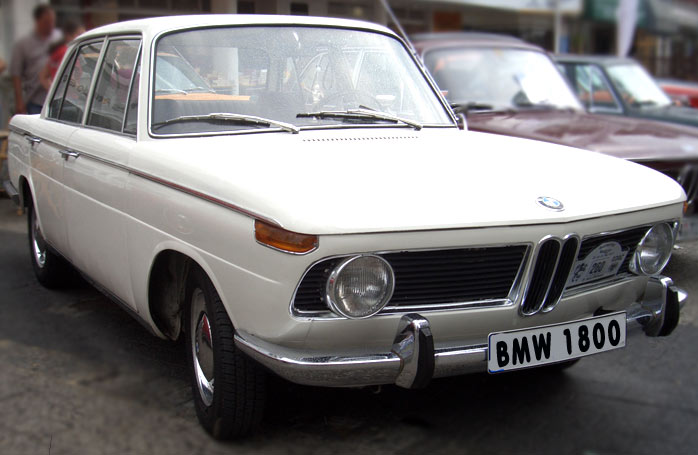 The next New Class sedan after the 1500 was the 1800, launched in September of 1963, with a 1773cc, 90 hp engine. Some interesting variations of the 1800 were the 1800 TI (18,417 units) and the rare 1800 TI/SA (200 units).
Produced from 1963 to 1972, there were 164,989 1800 units built. In original form, the base model 1800 had a top speed of 101 mph and a 0-60 time of 13 seconds.

BMW 2000CS (1965)
 To create the 2000CS, BMW first modified the New Class 2-liter engine, put it in the Karmann CS coupe body and added some Hofmeister design touches.
The engine modifications included twin two throat side draft carburetors. Like the New Class sedans, the 2000CS coupe had MacPherson strut front suspension with semi-trailing arms in the rear. The 1990cc four-cylinder engine produced 135bhp and could motor from 0-60mph in 11.3 seconds with a fuel rating of 23 mpg.
These cars are instantly recognizable by their distinctive front-end, especially the headlights. The headlight treatment placed two sets of front lights and turn signals within a wrap-around glass enclosure.
Advanced for its time, the design is similar to the front-end treatment on the E39 5 Series sedan and other contemporary BMW models. But the motoring press was critical of the design and after 11,720 C/CS cars were made (2837 2000C and 8883 2000CS) between 1965 and 1969, the 2000CS gave way to the BMW 2800CS (and the Europe-only 2.5CS), with a more conventional front-end treatment and a six-cylinder engine.
The interior of the 2000CS was very luxurious. BMW ads at the time said the car "handles like a Grand Prix champion" yet "feels like a long, silky limousine".
This 'limousine' had a sleek console and steering wheel, lots of wood trim and leather or two-tone plush cloth seats.

Thursday, September 6, 2007
BMW 1500 (1962)

With the medium-sized BMW 1500, BMW laid the foundation for a completely new class, or "new range." The four-door car was first presented at the 1961 Frankfurt Auto Show. It immediately set new standards for the automobile industry.
The main feature was a 4-cylinder engine of 80 hp with a maximum speed of 92 mph. The ingenious suspension combined safe driving and high performance, due particularly to the obliquely set trailing link on the rear axle. In the BMW 1500, BMW used McPherson spring struts for the first time. Although some 50 vehicles came off the line every day in the first half-year of production, the large demand could not be met.
BMW 3200CS (1962)

The 3200CS was the last thread of the BMW luxury V-8's of the 1950's, a forerunner of the New Six coupes, and the 6-Series sports coupes introduced in the 1970's.
Like the New Class BMW 1500, the 3200CS was shown at the 1961 Frankfurt Motor show.
Only 603 of these cars were produced over a four-year span, with a big 160hp V-8 engine and graceful styling by Nuccio Bertone.
Subscribe to:
Posts (Atom)


